
Twenty free home cleaning schedule templates in Microsoft Word. The template is the easy part — what makes a cleaning schedule survive past the second week is how you split the work and how honest you are about what fits in a day.
- Templates20 layouts
- FormatMicrosoft Word
- Opens inWord, Google Docs, LibreOffice
- CostFree, no signup
Zone cleaning or task cleaning?
There are two ways to organise a cleaning schedule, and most people drift between them without deciding. Picking one deliberately makes the whole thing easier to keep up.
| Approach | How it works |
|---|---|
| Zone cleaning | One room or area per day, done properly. Monday the kitchen, Tuesday the bathroom, and so on. Suits larger homes, and anyone who prefers finishing something visible each day. The downside is that a neglected zone stays neglected for a whole week. |
| Task cleaning | One job across the whole house per day. Monday all the floors, Tuesday all the surfaces. Efficient, because you set up and put away once. Suits smaller homes and flats, and anyone who finds switching tools mid-job annoying. |
| One big session | Everything in a block, usually at the weekend. Honest about how many people actually live, and fine if the daily tidying still happens. The risk is a session so long that it gets postponed. |
Whichever you choose, keep a short daily list alongside it. A schedule that only exists on Saturday means six days of accumulation.
The templates
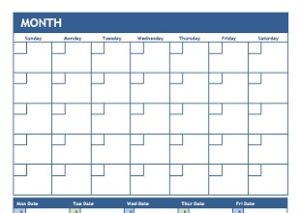
Twenty layouts, from simple weekly grids to detailed charts broken down by room and frequency. If more than one person will use it, pick one with space for names.


What belongs on each frequency
The common mistake is putting too much on the daily list, which makes it unachievable, and too little on the yearly one, which means those jobs never get planned at all.
| Frequency | Typical jobs |
|---|---|
| Daily 15–20 minutes total |
Dishes or dishwasher, wipe kitchen counters, tidy main living area, make beds, sort post. Anything that compounds badly if skipped. |
| Weekly 1–2 hours |
Vacuum and mop floors, bathrooms properly, change bedding, laundry, empty bins, dust surfaces, clear old food from the fridge. |
| Monthly | Wipe skirting boards and door frames, clean inside the microwave and oven, descale kettle and shower head, vacuum under furniture, wash bins, check smoke alarms. |
| Seasonal or yearly | Windows inside and out, curtains and blinds, behind and under large appliances, mattresses turned, wardrobes sorted, gutters, outdoor furniture, deep carpet clean. |
Put the seasonal jobs on the calendar rather than the schedule. They are the ones that quietly never happen otherwise, and four entries a year is enough.
Splitting it between people
This is where household cleaning schedules actually fall apart, and it is rarely about the cleaning.
- Assign whole jobs, not halves. “Dave does the bathrooms” works. “We both do the bathrooms” means a conversation every week.
- Write down who does what, visibly. Most of the friction comes from different people holding different assumptions, not from anyone refusing to help.
- Include the noticing, not just the doing. Whoever keeps track of what needs doing, when supplies run out and what is overdue is carrying real work. If that is always the same person, put that on the schedule too and rotate it.
- Rotate the disliked jobs rather than letting them settle permanently on whoever minds least.
- Match jobs to when people are actually home. A schedule built around an idealised week is a schedule nobody follows.
For children, give whole tasks appropriate to their age and let the standard be imperfect. A bed made badly by a seven-year-old is the point of the exercise.
Making the printed version last
-
Laminate it and use a dry-wipe marker
The single best thing you can do with a printed cleaning schedule. Tick the week off, wipe it clean on Sunday, start again. One print lasts a year instead of fifty-two. A clear plastic wallet works nearly as well if you have no laminator.
-
Put it where the work happens
The fridge door or the inside of a kitchen cupboard. A schedule in a drawer or a folder on a laptop is a schedule nobody consults.
-
Start with less than you think
Fill in about two-thirds of what you believe you can manage, and run it for a month. A schedule you beat is one you keep; a schedule you fail at every week gets taken down.
-
Revise it after a month
Move whatever consistently did not happen to a lower frequency, and add anything you found yourself doing that was not on it. The second version is always more realistic than the first.
Common questions
Do I need Microsoft Word?
No. Upload the file to Google Docs or open it in LibreOffice. If you want a version to tick off on your phone, Google Sheets works well for the grid-style layouts.
How long should cleaning actually take?
It depends entirely on the home and the standard, but most people overestimate what fits in a session. Time one week honestly before building a schedule around assumptions.
Can I use one of these for a cleaning business?
Yes. The room-by-room layouts work well as a checklist for staff or for leaving with a client as a record of what was done.
Pick a layout with named columns, assign whole jobs rather than shared ones, and rotate monthly. Agreeing it once in writing prevents most of the arguments that otherwise recur.
Should the schedule include outdoor jobs?
Put them on the seasonal list rather than the weekly one. Gutters, patios and outdoor furniture are a few times a year, and mixing them into the weekly grid makes it look unmanageable.
Can I use these commercially?
Yes, including for a cleaning business. You may not resell or redistribute the template files themselves. See our Terms of Use.




Pingback: Rental Agreement Templates for Landlords, Tenants and Deposits
Pingback: Occupancy Agreement Templates for Early Move-In and Rent-Back
Pingback: Daily Chore List Templates for Kids and Shared Homes
Comments are closed.