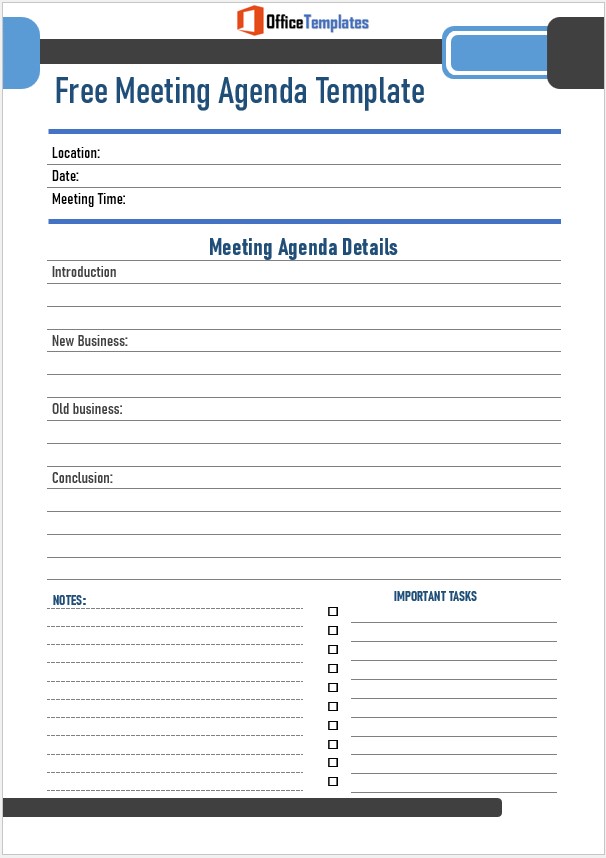
An agenda is not a list of topics. It is a decision about what the meeting is allowed to do — and for some bodies that is literally true, because anything not on the posted agenda cannot be voted on. Even in an ordinary team meeting the same principle holds informally: items written as subjects produce discussion, items written as decisions produce decisions. These four free meeting agenda templates give you the structure, and the sections below cover the conventions that make an agenda hold up.
This is the one change that improves every agenda, formal or not, and it costs nothing. An item that names a topic tells people what will be talked about. An item that names the decision tells them what they are being asked to do, which is the only thing that lets them prepare.
Subject — weak
Outcome — strong
Budget
Decide: approve the revised Q3 budget, or send it back for revision
Staffing update
Decide: whether to fill the two support roles internally or advertise
Website
Discuss: options for the website rebuild — no decision this month
Health and safety
Inform: annual inspection findings, no action required
Project Northfield
Decide: approve a four-week extension to Project Northfield
Marking each item decide, discuss or inform does two useful things. It tells attendees which items they must have read for, and it exposes the agenda that is nine-tenths inform — which is not a meeting, it is a newsletter being read aloud, and it should have been circulated as a memo instead. If an item has no outcome you can name, that is usually the discovery that it does not need a meeting slot.
Free meeting agenda templates
Each template holds the heading block, the items and the timings. Fill in the outcome type against each item before you circulate it rather than after.
If you are running anything with a constitution — a board, a committee, a society, a residents’ association — there is an established order, set out in Robert’s Rules of Order Newly Revised. Following it is not pedantry; it is what stops a meeting relitigating last month’s decisions before it reaches this month’s.
Opening the meeting
Call to order, and only once a quorum is present — quorum being the number of voting members who must be there for business to be legally transacted, as defined in your own governing documents. If quorum looks impossible, the chair can call the meeting to order and immediately announce that there is none.
Approval of minutes
The previous meeting’s record is approved, corrected or amended. This is about accuracy only — it is not the moment to reopen the underlying decision, which is where most meetings lose their first fifteen minutes.
Reports of officers, boards and standing committees
The standing reports, in a fixed order. Circulate them in writing beforehand so the slot is for questions rather than for reading aloud.
Reports of special committees
Anything from a group convened for one purpose. These often carry a recommendation, so say so on the agenda — a report that ends in a motion needs different preparation from one that does not.
Unfinished business
See the note below, because this heading is almost universally misunderstood.
New business
Items raised for the first time. Members can generally introduce a new matter here unless your rules require advance notice — which is exactly why bodies that make binding decisions tend to impose a notice requirement.
Closing the meeting
Announcements, the next meeting’s date, adjournment. Confirm the date before anyone leaves; chasing it afterwards takes a week of emails. For a body that meets on a fixed cycle, setting the whole year at once on a monthly calendar removes the question entirely.
“Unfinished business” does not mean “old business”. That common label is a misnomer, and the confusion causes real trouble. Unfinished business means three specific things: whatever was still pending when the last meeting adjourned, any items from that meeting’s agenda that were never reached, and anything formally postponed to this meeting. It does not mean any topic previously discussed. Two consequences follow. A chair should not ask “is there any unfinished business?” — they should simply state the question on the first such item, and if there is none, skip the heading altogether. And a member cannot use the heading to reopen a settled decision; that requires a motion to reconsider or rescind, under whatever your rules provide.
For a public body, the agenda is a legal limit
If the meeting is of a public or governmental body, the agenda stops being a convenience and becomes the boundary of the meeting’s authority. The specifics vary by jurisdiction, but California’s open-meeting law — the Brown Act — shows the shape of it clearly, and it is worth understanding even if you are elsewhere, because most open-meeting regimes work on the same logic.
Under that Act the agenda for a regular meeting must be posted at least 72 hours in advance, and for a special meeting the notice must be delivered and the agenda posted at least 24 hours beforehand. The agenda must contain a brief general description of each item of business to be transacted or discussed. And the critical part: the body generally may not act on an item that is not on the posted agenda. The exceptions are narrow — responding to statements or questions raised during public comment, asking clarifying questions of staff or the public, asking staff to report back on something at a later meeting, and making a brief announcement.
Read that together and the practical consequence is sharp. A vague agenda item does not merely leave people unprepared; it can prevent the body from doing the thing it meant to do, because a description too general to tell the public what is being decided will not support the decision. “Personnel matters” is the classic example of an item that sounds efficient and achieves nothing. The advice in the first section of this page — name the outcome, not the subject — is good practice everywhere and a requirement here.
Two cautions. The 72 hours is California’s figure, not a universal one: other US states and other countries set their own deadlines and their own rules about what counts as adequate description, and some bodies are governed by their own enabling legislation on top. And none of this is legal advice — if you are clerking a public body, work from your own jurisdiction’s statute and your authority’s legal guidance rather than from a template.
Timings, and the problem with “any other business”
Put a time against each item and a finish time on the meeting. Parkinson’s law — that work expands to fill the time available — applies to agenda items with some force: the same decision takes fifty minutes in an hour-long slot and twelve in a fifteen-minute one. Timings also make over-ambition visible before the meeting rather than during it, which is the same reason a project schedule totals its hours.
Order matters as much as duration. Put the item that most needs a decision early, while attention and attendance are both intact, rather than placing it after four reports because that is the order it arrived in. And be honest about how long the reports really need: if a standing report has produced no discussion in six months, it belongs in writing with a line on the agenda saying questions only.
Then there is any other business. It is nearly universal and it is where governance quietly fails, because it invites decisions on matters nobody prepared for, with no papers and no notice — and in a body subject to open-meeting rules, it is precisely the slot in which an unlawful decision gets taken. The usable version is to keep the heading but restrict it: items may be raised under it, not resolved. Anything substantive goes on the next agenda, which costs a month and saves the decision from being made by whoever is still in the room at five o’clock.
Finally, think about who is in the room rather than who is usually invited. A standing invitation list grows and never shrinks, and a meeting of fourteen where four are deciding is four people’s meeting and ten people’s afternoon. If you are unsure who genuinely needs to be there, an organogram settles who owns the decision faster than asking around does.
After the agenda: the part that makes it worth writing
An agenda is only half a system. The other half is what comes out, and the handover between them is where most of the value leaks away.
Record three things against each item as the meeting runs: the decision, who is doing what, and by when. Not a transcript — discussion is almost never worth writing down, while decisions always are. If an item produced no decision and no action, write that too, because an item that generates nothing twice should come off the agenda.
Then get the actions out of the minutes and into something that is actually tracked. Actions left in a minutes document are reviewed once a month at the next meeting, which is the slowest possible feedback loop; moved into an action plan or onto a task list they get looked at in the week they matter. The test of a good agenda is not how the meeting felt but whether anybody could tell, a fortnight later, what was decided and who was doing it.
Questions about meeting agendas
How far in advance should an agenda go out?
For an ordinary internal meeting, far enough ahead that people can read the papers — two to three working days is usually enough, and the same day is not an agenda, it is a warning. For formal bodies the answer is in your own rules: a constitution or standing orders will set a notice period, and a public body may be subject to a statutory deadline, such as the 72 hours California’s Brown Act requires for a regular meeting.
What is the difference between an agenda and minutes?
The agenda is written before and says what the meeting will address; the minutes are written after and record what it decided. They should share the same numbering, which sounds trivial and is the single easiest way to make both documents usable — item 4 on the agenda is item 4 in the minutes, so a decision can be traced to the thing that was proposed.
Does the agenda have to be approved at the start?
It depends on your rules. Many boards and committees adopt the agenda as a first item, which allows the meeting to agree any reordering openly rather than having the chair rearrange things on the fly. Where a body is bound by open-meeting legislation, adopting the agenda does not let it add substantive items that were not posted — the posting requirement is not something the meeting can vote away.
What if we do not have a quorum?
Then business cannot be legally transacted, and proceeding anyway creates decisions that can be challenged later. Quorum is defined in your governing documents. The practical response is to note the absence of quorum, deal with anything that genuinely does not require a vote, and adjourn — and then look at whether the quorum figure itself is realistic, because a body that routinely fails to reach it has either a membership problem or a badly drafted constitution.
Can someone add an item on the day?
In an informal meeting, of course, though it is worth asking whether it needs deciding today or just raising. In a formal one it depends on your notice rules, and in a public body subject to open-meeting law the answer is generally no for anything requiring action. Keeping a standing “items for the next agenda” line gives people somewhere to put it without derailing the meeting in front of you.
How long should a meeting agenda be?
Count minutes, not items. Add up the timings and compare them with the slot you have booked, allowing for the meeting starting a few minutes late and for one item overrunning, because one always does. Most overloaded agendas are not overloaded by one more item but by optimistic timings on every item, which is the same estimation error that wrecks weekly plans.
Can I edit these templates?
Yes — they are free to download, edit and print. Two edits are worth making to any of them: add a column for the outcome type against each item, and add one for the owner. A template that only has a topic column will quietly push you back towards writing subjects instead of decisions.