
Monthly budgets rarely fail because somebody overspent on coffee. They fail for an arithmetic reason: the costs that break a household do not arrive monthly. Insurance, car tax, Christmas, the dentist, the annual subscription — none of them appears on a budget built around a typical month, and together they are usually larger than whatever the budget showed as spare. These twenty free monthly budget templates in Microsoft Excel give you the grid. The section below is what to put in it.
- 20Monthly budget layouts
- ExcelEditable, with formulas
- 50/30/20Split explained correctly
- FreeNo sign-up, no email
The costs a monthly budget leaves out
Here is the problem, with numbers. The figures below are illustrative — replace them with your own, taken from last year’s bank statements rather than from memory — but the shape of the result is what matters.
| Cost that is not monthly | Per year |
|---|---|
| Car insurance | 480 |
| Vehicle tax | 190 |
| Service and roadworthiness test | 260 |
| Christmas | 600 |
| Birthdays and other gifts | 300 |
| One holiday | 1,200 |
| Dentist and optician | 140 |
| Boiler or heating service | 90 |
| Subscriptions billed annually | 160 |
| Total | 3,420 a year, which is 285 a month |
Two hundred and eighty-five a month, and it appears on none of the twelve monthly budgets. What happens instead is familiar: eleven months look fine, then one month the insurance renewal and the car service land together, the budget breaks, and it feels like a personal failure rather than a planning one. It was never in the plan.
The fix has a name — a sinking fund — and it is one line rather than a system. Total your irregular costs for the year, divide by twelve, and put that figure in your monthly budget as a fixed expense, as unarguable as rent. Move it to a separate savings account on payday so it is not available to spend. Then when the insurance arrives, it is already paid for.
Be ready for the number to be uncomfortable. On take-home pay of 2,400 a month, the 50/30/20 split below allocates 480 to saving and debt repayment — and a sinking fund of 285 consumes 59% of it. That is not a reason to skip the exercise; it is the exercise working. Knowing that most of your saving capacity is already committed to costs you had forgotten is the difference between a budget and a wish. If you want to see the full year rather than one month at a time, which is where irregular costs become visible, the annual budget sheets are the better starting point and this page becomes the month-by-month detail underneath.
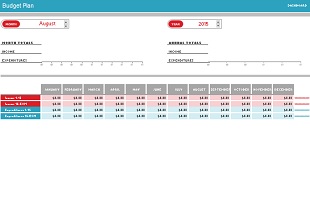
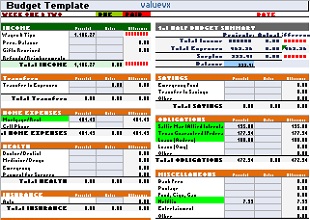
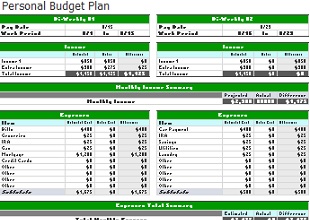
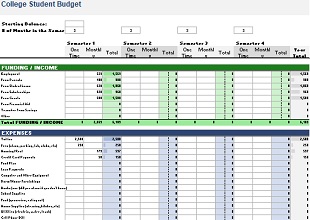
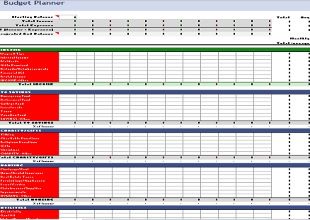
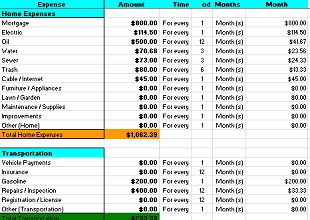
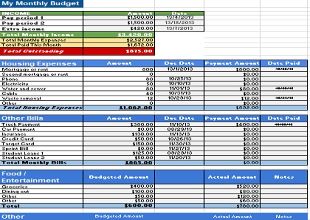
Free monthly budget templates
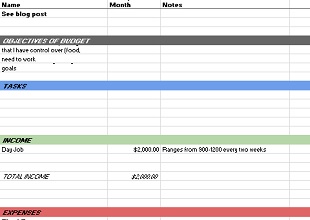
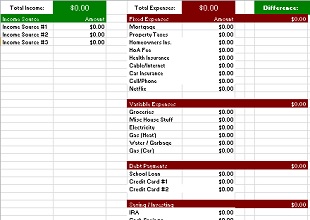
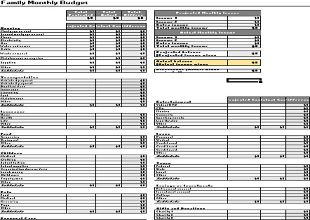
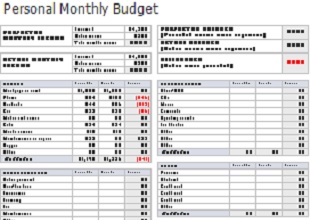
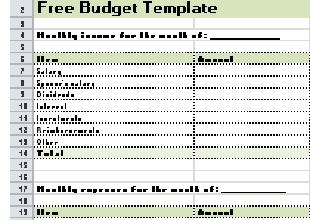
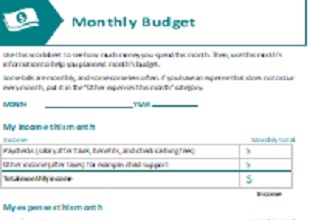
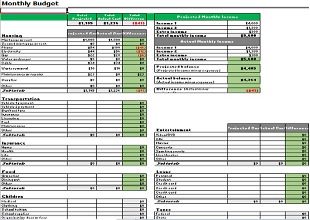
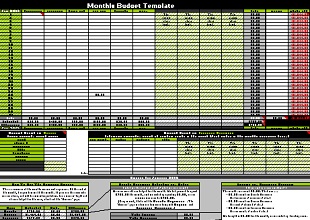
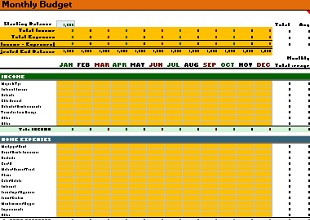
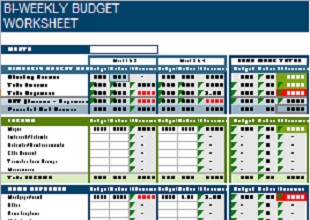
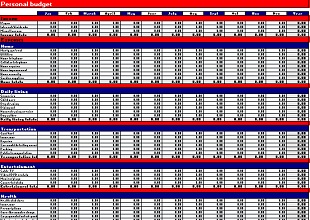
All twenty are Microsoft Excel workbooks, so the totals calculate themselves. File sizes are shown because a couple of them are substantially heavier than the rest.

The 50/30/20 split, applied properly
The best-known budgeting rule was popularised by Elizabeth Warren and Amelia Warren Tyagi in All Your Worth: The Ultimate Lifetime Money Plan (2006). It is genuinely useful as a sanity check, and it is also the rule most often applied wrongly, in two specific ways.
| Share | Category | What belongs in it |
|---|---|---|
| 50% | Needs | Housing, utilities, groceries, transport, insurance, childcare — and the minimum payments on any debt. |
| 30% | Wants | Eating out, entertainment, holidays, subscriptions, hobbies, anything you would stop buying if money got tight. |
| 20% | Debt, savings and investments | Payments above the minimum, an emergency fund of roughly three to six months of expenses, and retirement saving. |
First correction: the percentages are of take-home pay, not gross. Applying them to your salary before tax inflates every category and produces a budget that cannot balance, which is probably the commonest reason people conclude the rule does not work for them. Use the figure that actually lands in your account.
Second correction: minimum debt payments are a need, not saving. The minimum on a card or loan sits in the 50%, because you have no choice about paying it. Only what you pay above the minimum counts in the 20%. Getting this backwards flatters the budget considerably — it makes compulsory payments look like progress.
And the rule’s own limits are worth stating rather than glossing over. It is unrealistic for lower-income households, where needs alone can exceed everything coming in — the student budget templates are built for exactly that case, where the split is not a target but an arithmetic impossibility. It is hard in high-cost housing areas even on a good salary. And needs genuinely exceed half the budget for people supporting several children, helping elderly parents, or carrying significant medical costs. If the split does not fit your circumstances, the answer is to treat the percentages as a direction of travel rather than a target you have failed to hit.
The months with an extra payday
If you are paid monthly this does not apply. If you are paid weekly or fortnightly, your budget has a structural quirk that is worth exploiting rather than being surprised by.
Paid weekly, you receive 52 payments a year. Four payments a month across twelve months accounts for only 48, so four months of the year contain five paydays. Paid fortnightly, you receive 26 payments; twelve months at two each accounts for 24, so two months contain three. Most people budget as though every month is the same and then treat the extra payment as a windfall, which is how it gets spent.
Used deliberately, those extra paydays are the easiest money in the year to save, because the budget is already balanced without them. Identify which months they fall in — it takes five minutes with a calendar — and assign them in advance: to the sinking fund, to a debt, or to the emergency fund. Deciding in January what November’s fifth payday is for is considerably easier than deciding in November.
Which of the twenty to use
| Your situation | What to look for |
|---|---|
| Starting from nothing | The simplest sheet with the fewest categories. A budget you will actually fill in beats a thorough one you abandon in week two. |
| You already know roughly where the money goes | A template with budgeted-against-actual columns, so you can see variance rather than just intention. |
| Two incomes, different paydays | One that handles income by date rather than as a single monthly figure. |
| Paying down debt | One with debt tracked as its own section, so minimum and extra payments stay visibly separate. |
| Sharing a house | A sheet that splits bills between people, rather than a single household column. |
| You want the year, not the month | One of the twelve-tab workbooks, or move up to a full-year sheet. |
Whichever you choose, add two rows the standard templates lack: the monthly sinking fund figure from the first section, and a line for the extra payday months if you are paid weekly or fortnightly. Those two rows are the difference between a budget that survives a year and one that breaks in month three.
One habit matters more than the template. A budget is a forecast, and a forecast is only useful if you compare it with what happened — so spend ten minutes at the end of each month putting the actual figures beside the planned ones. Without that step the sheet is a statement of intent that nobody ever checks. If tracking spending as it happens suits you better than reconciling at month end, a weekly expense report is the lighter-touch way to keep the actuals honest.
Questions about monthly budgets
Why does my budget work for a few months and then collapse?
Almost always the irregular costs. A budget built from a typical month contains none of the annual bills, so it shows more spare money than exists, and the first renewal or repair breaks it. Total your non-monthly costs for the year, divide by twelve, and put that in as a fixed line. The budget will look worse and behave far better.
Is 50/30/20 based on gross or net income?
Net — your take-home pay after tax. This is the most common mistake in using the rule: applied to gross salary it allocates money you never receive, the budget cannot balance, and the rule gets blamed. Deductions such as pension contributions and health insurance premiums are treated as part of take-home pay and counted within the categories.
Do minimum debt payments count as savings or as needs?
Needs. The minimum payment is compulsory, so it belongs in the 50%. Only the amount you pay above the minimum counts towards the 20% for debt and savings. Counting the whole payment as debt repayment makes a budget look much healthier than it is, because it treats an obligation as progress.
How much should the emergency fund be?
Roughly three to six months of expenses is the usual guidance, and note that it is months of expenses rather than months of income — a meaningful difference. Where you sit in that range depends on how secure and how variable your income is: steady salaried work at the lower end, self-employment or commission at the higher. Building it is one of the three things the 20% is for.
Should I budget by month or by payday?
By payday if you are paid weekly or fortnightly, because a calendar month is not a unit your money arrives in, and forcing it into one is what produces the extra-payday confusion described above. Monthly works cleanly for monthly salaries. What matters either way is that every expense has been assigned to a specific pay period rather than to the month in general.
What about the “miscellaneous” category?
Keep it small and watch it. A miscellaneous line is useful for genuinely unpredictable small amounts, but it becomes the place where an unexamined third of the spending hides. If it is consistently the largest variable category, the next month’s job is to break it into real categories — the discovery is usually the point of budgeting at all.
Can I edit these templates?
Yes — they are ordinary Excel workbooks, free to download and change, with the formulas already in place. Rename the categories to match your actual spending rather than working around someone else’s labels, and add the sinking fund row. If a budget is for one specific thing rather than the household as a whole — a trip, a wedding, Christmas — a purpose-built sheet such as the holiday budget will fit better than adapting a monthly one, and the budget worksheets hub lists the rest by purpose.




Pingback: Grocery List Templates and How to Shop From One
Pingback: Check Voucher Templates and How to Approve a Payment
Pingback: Loan Payment Schedule Templates and the Two Ways to Repay