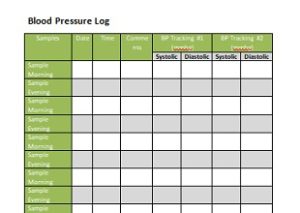
An employment application form is probably the most legally constrained routine document an employer produces, and the risk runs the opposite way to most paperwork: the danger is not what you forget to ask but what you ask. A single health question on a form, asked before an offer, is unlawful in Great Britain and restricted in the United States — and the line falls in places that are genuinely counter-intuitive. These four free employment application templates cover the structure. The sections below cover the questions to take off it.
- 4Application form layouts
- EditableCustomise and print
- CheckedLawful-question guidance
- FreeNo sign-up, no email
General information, not legal advice. Recruitment rules differ by country and, in the United States, by state and city — and a template cannot know where you are. Nothing below makes a form compliant; it tells you which questions to look at before someone qualified signs it off. If you are designing a form that will be used at scale, have it reviewed once by an employment lawyer in your jurisdiction. That is a cheap piece of work relative to a discrimination claim.
The questions that create the risk
Most employers write an application form by listing what they would like to know. That is the wrong starting point, because several of the most natural questions are the restricted ones — health, age, salary history, criminal record — and a form is worse than an interview here, since it asks every candidate the same unlawful question in writing and keeps the evidence.
One thing worth settling before you write a single field: who is actually running the recruitment, who sees the completed forms, and who makes the decision. Forms that circulate to everyone with an opinion are how protected information reaches people who should never have had it, and an organogram is a quick way to establish who the decision belongs to before the applications start arriving.
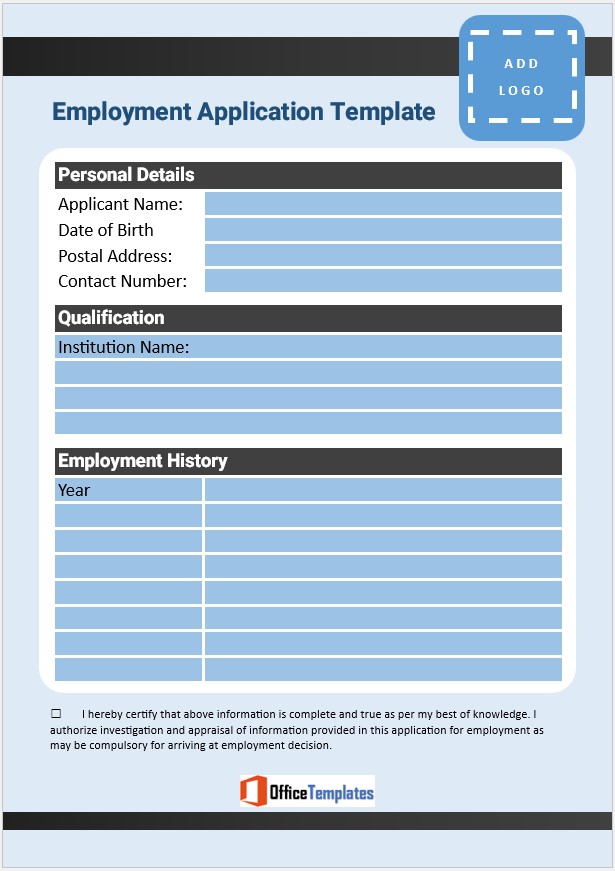
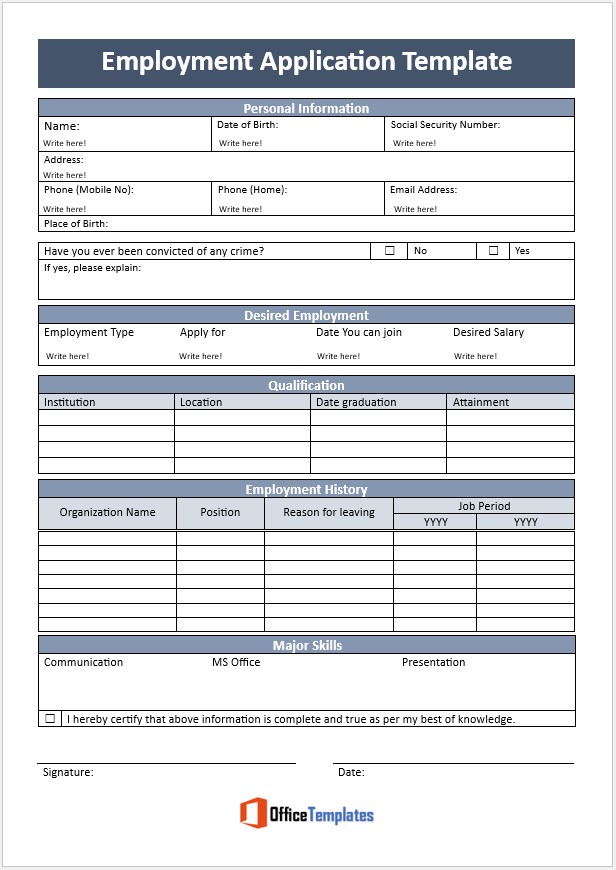
Free employment application templates
Each template is editable, so remove any field you do not need. Deleting questions is the main work here — a shorter form gets completed more often and carries less risk.


In Great Britain: no health questions before an offer
Section 60 of the Equality Act 2010 makes it generally unlawful to ask about disability or health before you make a job offer. The Equality and Human Rights Commission’s guidance for employers is unambiguous about the scope, and the scope is wider than people expect.
It covers questions asked by the employer or by anyone acting for them, at any point in recruitment up to the offer, written or verbal. It also covers questions put to third parties — so asking a previous employer about someone’s sickness record during a reference check is caught by the same rule. What you may do instead is make a conditional offer and ask health questions after it, which is why pre-employment medicals and occupational health referrals normally sit at that stage rather than earlier. It is also the natural point for the rest of the offer paperwork, including any confidentiality agreement the role requires — none of which belongs on an application form.
There are seven exceptions, and they are narrower than the phrase “exceptions” suggests:
-
Taking part in an assessment
Whether the applicant can participate in a test or interview, or needs adjustments in order to. This is the one most employers actually need.
-
An intrinsic part of the job
Whether the applicant can carry out a function that is genuinely intrinsic to the role — not merely convenient, and not a task that could be reassigned.
-
An occupational requirement
Where having a particular disability is itself a requirement of the post.
-
Diversity monitoring
Permitted, but it must be kept separate from the application form and from the people assessing it. A monitoring question sitting in the middle of the application is not this exception.
-
Positive action
Where the employer is taking positive action in favour of disabled people.
-
Another legal requirement
Where separate legislation obliges the question — medical fitness certificates for seafarers being the example the guidance gives.
-
National security vetting
Vetting applicants for national security purposes.
The enforcement position is worth getting right, because it is widely misstated. An applicant cannot sue you merely for asking the prohibited questions — compliance with section 60 is regulated by the EHRC, which can take enforcement action where proportionate. But if you then do not select that applicant, or you withdraw an offer, because they are disabled or you think they are, they can bring a disability discrimination claim and you may pay damages. So the question is a regulatory exposure and the decision following it is the litigation exposure — which is precisely why having asked is so unhelpful: it supplies the evidence of what you knew.
In place of health questions, the guidance suggests asking about adjustments needed for the recruitment process at the appropriate stage, and otherwise concentrating on job-related skills, knowledge, abilities and experience — for instance asking a candidate to describe how they handled a difficult situation or a tight deadline.
In the United States: the near-misses under the ADA
The American position is not a blanket ban but a line between ability and condition, and the pairs below — from the Job Accommodation Network’s pre-offer guidance — show where it falls better than any general principle.
| You may ask | You may not ask |
|---|---|
| “Are you able to perform the essential function of the job you are seeking, with or without accommodations?” | “Do you have any physical or mental impairment that would keep you from performing the job you seek?” |
| “Can you meet our attendance requirements?” — and how many days the applicant was absent from a previous job | “How many days were you sick during your last job?” |
| “How did you break your leg?” | “Do you expect the leg to heal normally?” |
| “Are you currently using illegal drugs?” and “Have you ever used illegal drugs?” | “Have you ever been treated for drug addiction?” or “Have you ever participated in an alcohol rehabilitation program?” |
| “Do you drink alcohol?” | “What medications are you currently taking?” |
The second row is the one to internalise. Absences in general are a fair question; sickness absence specifically is not — because the first asks about reliability and the second asks about health. The third row makes the same point from the other direction: how an injury happened is a past event, whereas whether it will heal is a question about a possible ongoing impairment. Almost every unlawful question on an application form is a lawful one that drifted across that boundary, usually by adding the word “sick”, “medical” or “condition”.
Three more fields worth a second look
Salary history. Many US states and cities now restrict or prohibit asking what an applicant currently earns, on the basis that anchoring an offer to past pay carries forward existing pay gaps. Since the rules differ by location and a form is used everywhere at once, the practical answer for a multi-state employer is to drop the field and ask about salary expectations instead. Check your own jurisdiction rather than assuming either way.
Criminal record. A large number of US jurisdictions have fair chance or “ban the box” laws restricting criminal-history questions on an initial application, typically deferring them to a later stage. In Britain the position turns on whether a conviction is spent and on whether the role is one for which a higher level of disclosure is lawful. Either way, a blanket “have you ever been convicted of a crime?” box on page one is the version most likely to be unlawful somewhere you operate.
Date of birth and graduation dates. Neither is usually necessary to decide whether to interview someone, and both act as a proxy for age. If you need a date of birth for payroll or for a right-to-work check, collect it after an offer, along with everything else that belongs in the personnel file rather than in a selection decision.
What the form should collect
With the restricted fields removed, what remains is more useful than most application forms manage.
| Section | What to ask for |
|---|---|
| Contact details | Name, email, phone. A postal address is rarely needed before an offer. |
| Role applied for | Including where they saw it advertised, which is the cheapest recruitment analytics you will ever collect. |
| Employment history | Employer, dates, role and what they were responsible for. Leave room for gaps to be explained without requiring a reason. |
| Qualifications relevant to this role | Named qualifications where the job genuinely requires them. Not dates of attendance. |
| Skills against the person specification | Ask candidates to evidence each requirement. This is what makes a form better than a CV, because everyone answers the same questions. |
| Right to work | Whether they are authorised to work in the country. Documents are checked after an offer, not collected on a form. |
| Adjustments for the process | Whether they need any adjustment to take part in the interview or assessment. One of the seven permitted areas. |
| References | Names and contact details, with consent to approach them and a tick box for not contacting a current employer before an offer. |
| Declaration and signature | That the information is accurate, with a note that material false statements may affect employment. |
Two things that should not be on the form itself: diversity monitoring questions, which belong on a separate sheet detached before assessment, and anything you only need after an offer. Keep a clear line between selection information and personnel-file information, and the form stops being a liability. Everything on the far side of that line — payroll details, emergency contacts, the leave request process — starts once somebody has accepted the job, not while you are deciding whether to offer it.
It is also worth deciding at this point what happens to the applications you do not take forward — who stores them, for how long, and who deletes them. Unsuccessful applications are a quiet accumulation of personal data about people with no ongoing relationship to you, and retention periods come from your own jurisdiction’s rules rather than from a template. Set a period, write it on the privacy notice, and then actually apply it.
Questions about employment application forms
Can I ask about health or sickness absence on the form?
In Great Britain, generally no — section 60 of the Equality Act 2010 makes health and disability questions before a job offer unlawful, including questions put to a previous employer, with only seven narrow exceptions. In the United States you may ask whether someone can perform the essential functions of the job and whether they can meet attendance requirements, but not about sickness absence, medications or impairments. In both places the compliant route is to make a conditional offer first and ask afterwards.
Is an application form better than accepting CVs?
For comparability, yes. A form makes every candidate answer the same questions against the same person specification, which is both fairer and far easier to shortlist from than a stack of differently structured CVs. The trade-off is that forms deter some strong candidates, particularly for senior roles, because they take longer to complete. Many employers use a form for high-volume roles and accept CVs for specialist ones.
Should I ask for a date of birth?
Not before an offer. It is almost never needed to decide whether to interview someone, and it is a direct proxy for age. The same goes for the years somebody attended school or university. Collect what payroll and right-to-work checks require once you have made an offer.
Can I include diversity monitoring questions?
Yes, but on a separate sheet or screen that is detached from the application before anyone assesses it. Monitoring is one of the permitted purposes precisely because the answers are not meant to reach the selection decision. A monitoring section printed in the middle of the application form defeats the exception it relies on.
When can I contact references?
With the applicant’s consent, and for a current employer usually only after an offer — approaching someone’s existing manager before then can cost them their job if they are not successful. Give candidates a tick box for exactly that. Remember too that in Britain you cannot ask a referee the health questions you could not have asked the applicant.
What should the form say about data?
Who is collecting the information, what it will be used for, who will see it, how long it will be kept and how to ask for it to be deleted. That is a privacy notice rather than a clause, and it can sit on a second page or be linked. The detail is set by your jurisdiction’s data protection law, so take the retention period from your own policy rather than from any template.
Can I edit these templates?
Yes — they are free to download, edit and print. Before you use one at scale, go through it and delete every field you cannot justify against the role, paying particular attention to anything about health, age, salary history or criminal record. These files are a structure, not a compliance check, and the old version of this page was wrong to suggest otherwise. Once the fields are settled, the same discipline applies to every document that follows, right through to the warning notice you hope never to need.